Complete Software Project Development: From Concept to Delivery & Billing
# Complete Software Project Development: From Concept to Delivery & Billing
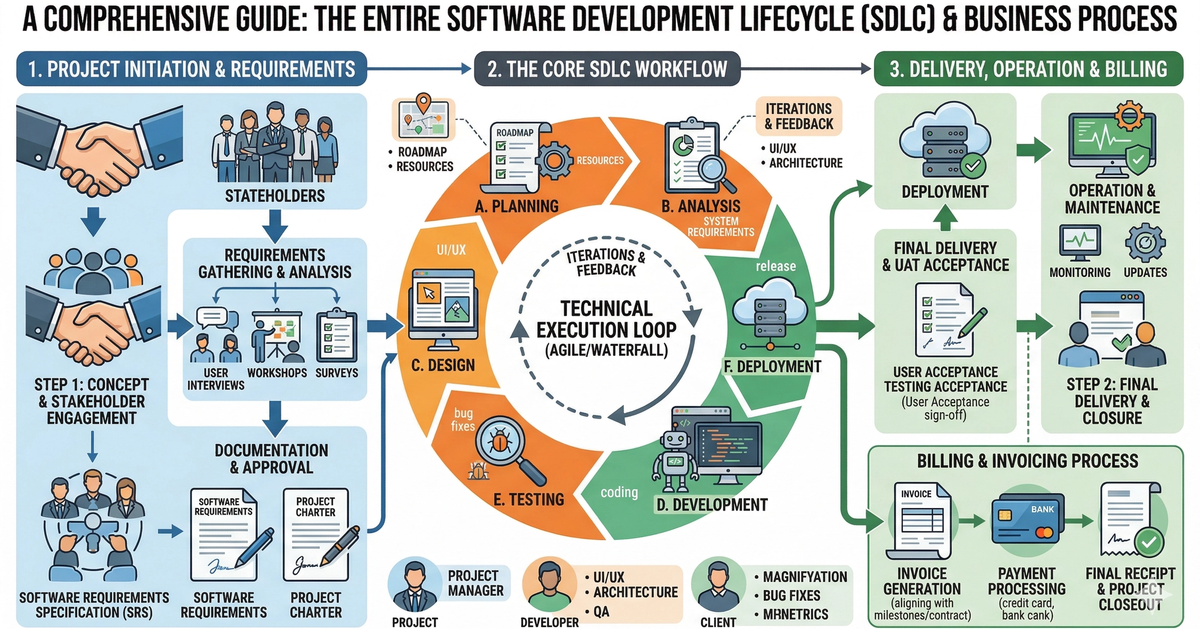
At Onedaysoft, we've refined our software development process through years of delivering AI-powered solutions and custom software projects. Understanding the complete lifecycle from initial concept to final billing is crucial for both development teams and clients. This comprehensive guide walks you through each phase of our proven methodology.
Phase 1: Discovery and Requirements Analysis
The foundation of any successful software project lies in thorough discovery and requirements gathering. This phase typically spans 1-2 weeks and involves several critical activities:
Initial Client Consultation
- Stakeholder interviews: Meet with key decision-makers and end-users
- Business objective mapping: Understand the core problems the software will solve
- Technical constraints assessment: Evaluate existing systems and infrastructure
- Budget and timeline discussions: Establish realistic expectations
Requirements Documentation
We create detailed documentation that includes:
- Functional requirements (what the system should do)
- Non-functional requirements (performance, security, scalability)
- User stories and acceptance criteria
- Technical specifications and architecture diagrams
**Example User Story:**
As a [user role], I want to [action] so that [benefit/value]

Acceptance Criteria:
- Given [context]
- When [action occurs]
- Then [expected outcome]
Phase 2: Planning and Architecture Design
Once requirements are clear, we move into the planning phase where we design the technical architecture and project roadmap.
Technical Architecture
- 1.System design: Create high-level architecture diagrams
- 2.Technology stack selection: Choose appropriate frameworks and tools
- 3.Database design: Plan data structures and relationships
- 4.API specifications: Define endpoints and data flows
- 5.Security considerations: Implement security measures from the ground up
Project Planning
- Sprint planning: Break down work into manageable sprints (typically 2-week cycles)
- Resource allocation: Assign team members based on expertise
- Risk assessment: Identify potential challenges and mitigation strategies
- Milestone definition: Set clear deliverable checkpoints
Phase 3: Development and Implementation
This is where the actual coding begins. Our development phase follows agile methodologies with continuous integration and deployment practices.
Development Workflow
- 1.Sprint kickoff: Team reviews sprint goals and tasks
- 2.Daily standups: Quick progress updates and obstacle identification
- 3.Code development: Following best practices and coding standards
- 4.Code reviews: Peer review process for quality assurance
- 5.Testing: Unit tests, integration tests, and automated testing
Quality Assurance
- Automated testing: Continuous integration with automated test suites
- Manual testing: User interface and user experience testing
- Performance testing: Load testing and optimization
- Security testing: Vulnerability assessments and penetration testing
# Example: Automated testing setup
import pytest
from app import create_app

def test_api_endpoint():
    app = create_app()
    client = app.test_client()

    response = client.get('/api/health')
    assert response.status_code == 200
    assert response.json['status'] == 'healthy'
Phase 4: Testing and Quality Assurance
Comprehensive testing ensures the software meets all requirements and performs reliably in production environments.
Testing Strategy
- Unit Testing: Individual component testing (target: 80%+ code coverage)
- Integration Testing: System component interaction testing
- User Acceptance Testing (UAT): Client validation of functionality
- Performance Testing: Load and stress testing
- Security Testing: Vulnerability scanning and assessment
Bug Tracking and Resolution
- 1.Issue identification: Systematic bug discovery and documentation
- 2.Priority classification: Critical, high, medium, low priority levels
- 3.Resolution and verification: Fix implementation and testing
- 4.Regression testing: Ensure fixes don't break existing functionality
Phase 5: Deployment and Delivery
The deployment phase involves moving the software from development to production environment and ensuring smooth operation.
Deployment Strategy
- Staging environment: Pre-production testing environment
- Production deployment: Carefully orchestrated live deployment
- Rollback procedures: Emergency rollback plans if issues arise
- Monitoring setup: Real-time application and infrastructure monitoring
Knowledge Transfer
- 1.Documentation delivery: Complete technical and user documentation
- 2.Training sessions: User training and administrative training
- 3.Support procedures: Ongoing support and maintenance guidelines
- 4.Handover meetings: Final project review and sign-off
Phase 6: Billing and Project Closure
The final phase involves project closure activities and financial settlement.
Billing Process
- Time tracking verification: Review all logged hours and activities
- Deliverable confirmation: Ensure all contracted deliverables are complete
- Invoice generation: Detailed invoice with work breakdown
- Payment processing: Follow agreed payment terms and methods
Project Documentation
- Final project report: Comprehensive project summary
- Lessons learned: Document insights for future projects
- Asset handover: Transfer of all code, documentation, and credentials
- Warranty and support: Outline post-delivery support terms
Conclusion
A structured approach to software development ensures successful project outcomes and satisfied clients. At Onedaysoft, our proven methodology combines technical excellence with clear communication and transparent processes. By following this comprehensive framework, we deliver high-quality software solutions that meet business objectives while maintaining strong client relationships.
The key to success lies in maintaining flexibility within the structure, adapting to project-specific needs while adhering to core principles of quality, transparency, and client satisfaction.